Showing posts with label tarot spreads. Show all posts

Tuesday, December 30, 2025

Beyond Spreads – Creative Ways to Work With Tarot Outside of Readings

For many people, tarot begins — and ends — with spreads. Cards are shuffled, laid out, interpreted, and then neatly put away until the next question arises. But tarot is far more versatile than that. In truth, spreads are only one doorway into a much larger relationship with the cards.

Tarot is a symbolic system, a creative language, and a reflective tool that can be woven into daily life in countless ways. When you move beyond spreads, tarot stops being something you do occasionally and becomes something you live with. It supports creativity, mindfulness, emotional processing, spiritual growth, and self-awareness — even when you’re not asking a single question.

This post explores creative, grounded, and meaningful ways to work with tarot outside of traditional readings, opening your practice up into something richer, more personal, and more sustainable over time.


Why Move Beyond Spreads at All?

Spreads are powerful, but they’re also structured. Sometimes that structure helps focus intuition — and sometimes it limits it. If you’ve ever felt stuck, burned out, or overly dependent on readings, expanding your tarot practice can be incredibly refreshing.

Working with tarot beyond spreads helps you:

  • Deepen your relationship with your deck
  • Strengthen intuition without pressure
  • Avoid over-reading or reassurance-seeking
  • Integrate tarot into everyday life
  • Use tarot as a creative and reflective tool

Tarot doesn’t require a question to be meaningful. Sometimes the most powerful insights come when you stop asking and start listening.


Daily Card as Reflection, Not Prediction

One of the simplest non-spread practices is the daily card — but with a shift in intention.

Instead of asking, “What will happen today?” try:

  • What energy wants my attention today?
  • What theme should I stay mindful of?
  • What lesson is gently present?

Then don’t try to interpret it immediately. Carry the card’s imagery with you throughout the day. Notice how it shows up in subtle ways — in conversations, emotions, choices, or inner reactions.

This turns tarot into an ongoing conversation rather than a one-time answer.


Tarot Journaling as Inner Dialogue

Tarot journaling doesn’t require spreads at all. One card is enough.

Choose a card and explore it through writing:

  • What stands out visually?
  • What emotion does it evoke?
  • What memory or association arises?
  • Where does this energy exist in my life?

You can also journal as the card:

  • Write a letter from the card to yourself
  • Ask the card what it wants you to know
  • Let the card narrate a current situation

This practice deepens your personal symbolic language and strengthens intuition through reflection rather than analysis.


Tarot for Emotional Processing

Tarot is exceptionally effective for emotional awareness — even when you don’t want answers.

Try pulling a card simply to name what you’re feeling:

  • This card represents my current emotional state
  • This card shows what I’m avoiding
  • This card reflects what I need to feel safe

Tarot gives emotion form. Instead of being overwhelmed by unnamed feelings, you can externalize them — see them, understand them, and sit with them compassionately.

This is especially helpful during times of stress, grief, burnout, or transition.


Meditating With Tarot Imagery

Tarot cards are visual meditations waiting to happen.

Choose a card and spend time simply observing it:

  • Notice colors, shapes, and movement
  • Follow your eye around the image
  • Imagine stepping into the card’s world

You might visualize:

  • Standing beside the figure
  • Asking them a question
  • Feeling the atmosphere of the scene

This kind of meditation strengthens intuitive perception and emotional clarity without needing interpretation or outcome.


Tarot as a Creative Muse

Tarot has long been used as a creative catalyst — and for good reason. The cards are rich with narrative, symbolism, and emotional depth.

Creative ways to use tarot include:

  • Writing short stories inspired by a card
  • Creating poetry based on card imagery
  • Drawing or painting your interpretation of a card
  • Using cards as prompts for journaling or art
  • Designing playlists inspired by specific cards

You can also pull cards to explore character development, themes, or emotional arcs — especially helpful for writers and artists.

Tarot doesn’t just reflect creativity. It awakens it.


Tarot for Mindfulness and Presence

Tarot can anchor you in the present moment when your mind feels scattered.

Try:

  • Pulling a card and focusing on its imagery for one full minute
  • Using the card as a breathing focus
  • Noticing how your body reacts to the card

This turns tarot into a mindfulness practice rather than a divination tool. You’re not seeking answers — you’re cultivating awareness.


Tarot as a Self-Check-In Tool

Instead of asking big questions, tarot can help you gently check in with yourself.

Examples:

  • What part of me needs attention today?
  • What boundary needs strengthening?
  • What energy am I carrying that isn’t mine?
  • What would support me right now?

These aren’t predictive questions. They’re compassionate ones.

Tarot becomes a form of self-care rather than a source of pressure.


Working With One Card for Extended Time

Instead of pulling multiple cards, try working with one card for a week or month.

Ways to do this:

  • Place the card somewhere visible
  • Journal about it periodically
  • Notice how it appears symbolically in daily life
  • Reflect on how your relationship with it evolves

This deepens understanding and builds intimacy with the tarot language.


Tarot as Ritual, Not Reading

Tarot doesn’t have to answer questions to be sacred.

You might:

  • Shuffle the deck as a grounding ritual
  • Hold the cards during meditation
  • Use tarot to open or close your day
  • Incorporate cards into seasonal or personal rituals

Ritual use strengthens your energetic connection to tarot without expectation or outcome.


Tarot and Shadow Awareness

Beyond spreads, tarot can gently highlight unconscious patterns.

You might pull a card and ask:

  • What am I not seeing?
  • What part of myself wants acknowledgment?
  • What pattern is repeating?

Then sit with the card without trying to fix anything.

Awareness itself is the work.


Letting Tarot Be Playful Again

When tarot becomes rigid or serious, it loses some of its magic. Creative, non-reading practices bring playfulness back into the relationship.

You can:

  • Pull cards just to admire the artwork
  • Sort cards by mood or theme
  • Create personal keywords for each card
  • Explore how different decks express the same archetype

Play strengthens intuition by reducing pressure and expectation.


When Tarot Isn’t About Answers

Some of the most meaningful tarot moments happen when you aren’t seeking clarity — only connection.

Tarot can be:

  • A mirror
  • A comfort
  • A creative spark
  • A grounding tool
  • A quiet companion

When you release the need for answers, tarot meets you in presence.


Building a Sustainable Tarot Practice

Working beyond spreads helps prevent burnout, dependency, and over-questioning. It allows tarot to support your life without dominating it.

A sustainable tarot practice:

  • Honors intuition without obsession
  • Encourages reflection over reassurance
  • Balances structure with creativity
  • Evolves naturally over time

Tarot thrives when it’s allowed to breathe.


The Heart of the Practice

Tarot was never meant to be confined to layouts and positions alone. It is a symbolic language, an emotional compass, and a creative partner that can walk beside you through daily life.

When you move beyond spreads, tarot becomes less about predicting what’s next and more about understanding what’s now. It meets you in reflection, creativity, mindfulness, and self-awareness — quietly shaping insight through presence rather than answers.

Sometimes the most powerful tarot work happens when no spread is laid at all.

And in those moments, the cards are speaking more clearly than ever.

Tuesday, September 16, 2025

Creating Your Own Tarot Spreads for Specific Questions

Tarot spreads are like maps. They give structure to the journey you’re about to take with your cards, helping you navigate from the question in your mind to the insight the cards are offering. While classic spreads like the three-card past–present–future or the Celtic Cross have stood the test of time, one of the most empowering things you can do as a tarot reader is create your own spreads. A custom spread allows you to frame the reading in a way that speaks directly to your needs and concerns, making the answers you receive more relevant and personal.

In this post, we’ll explore why you might want to design your own tarot spreads, how to approach the process step by step, and some practical examples you can try for yourself.


Why Create Your Own Tarot Spreads?

Pre-made spreads are wonderful, especially when you’re starting out. They offer tested structures that cover broad themes like love, career, or personal growth. But sometimes, those general shapes don’t quite fit the situation you’re in.

Maybe your question is very specific, like:

  • “How can I best prepare for this job interview?”
  • “What lessons should I take from this breakup?”
  • “Where should I focus my energy during this new moon?”

A standard spread might feel too generic, leaving you wishing for sharper insight. By crafting your own, you’re tailoring the spread to your exact needs, ensuring each card position is aligned with what you truly want to know. It also deepens your relationship with the cards, helping you think critically about the nature of your questions and the layers of meaning you want to explore.


Step One – Define Your Question

Every good tarot spread begins with a clear question. Instead of starting with the cards, start with yourself. What do you want guidance on? Be as specific as possible.

For instance, instead of asking, “Will I get a new job?” you could reframe the question into, “What can I do to improve my chances of finding the right job?” That subtle shift gives you more control and leads to a spread that focuses on actionable advice rather than yes-or-no outcomes.


Step Two – Identify the Aspects You Want to Explore

Once you know your core question, break it into parts. Think of the angles you’d like the reading to cover. For example, if your question is about a job interview, you might want to explore:

  • How you can best present yourself
  • The challenges you may face
  • The strengths you bring
  • The likely outcome

Each of these aspects can become a card position in your spread. This step is where the magic of customization shines—your spread grows naturally out of your question.


Step Three – Decide on the Number of Cards

More isn’t always better. A spread with three to five cards can often be more insightful than a sprawling ten-card layout. Too many cards can overwhelm you, especially when your question is narrow.

Here are some guidelines:

  • One card: Perfect for daily draws or very simple questions.
  • Three cards: Great for short-term guidance, comparisons, or “this–that–outcome” style questions.
  • Five to seven cards: Useful for multi-faceted questions where you want more detail.
  • Ten or more cards: Best reserved for complex readings, like life overviews or yearly forecasts.

Step Four – Assign Meaning to Each Position

Now comes the creative part—naming your positions. Each card should have a clear role to play. Think about phrasing that’s specific and personal. For example:

Instead of saying “Card 1: Past,” try “Card 1: What past lesson still influences this situation?”

The more intentional your phrasing, the easier it will be to interpret the card that lands there. Don’t be afraid to get poetic. Tarot thrives on symbolism, and a beautifully worded position can spark intuitive leaps.


Step Five – Sketch the Layout

Visuals matter. Whether you place your cards in a straight line, a circle, or a shape that symbolizes your question (like a heart for love readings or a staircase for progress), the layout can add another layer of meaning.

It doesn’t need to be complicated. Draw it on paper, decide where each card will go, and jot down its position meaning. Over time, you’ll develop favorite patterns that feel natural to you.


Step Six – Test and Adjust

The first time you use your spread, treat it as an experiment. Pull the cards, read them, and then reflect: did the structure give you the clarity you were hoping for? If not, tweak it. Maybe you need fewer cards, or maybe one position felt redundant. Designing spreads is an evolving process.

Remember—tarot is flexible. You’re not bound to the first draft of your spread. Adjust until it feels like it flows.


Example Custom Spreads

Here are three sample spreads you can use as inspiration:

1. The Crossroads Spread (4 cards)

For when you’re facing a decision.

  1. Path A – What this path offers
  2. Path B – What this path offers
  3. Hidden influences – What you may not see
  4. Guidance – What the cards advise

2. The Healing Spread (5 cards)

For emotional recovery after a difficult experience.

  1. The wound – What still hurts
  2. The root – Where this pain comes from
  3. The balm – What helps you heal
  4. The lesson – What this experience teaches
  5. The gift – How this shapes your future

3. The New Moon Spread (6 cards)

For setting intentions and aligning with lunar energy.

  1. What energy is leaving with the old cycle
  2. What energy is entering now
  3. What to release
  4. What to embrace
  5. Where to focus intention
  6. The potential outcome

Final Thoughts

Creating your own tarot spreads is both an art and a practice. It allows you to move beyond cookie-cutter readings and step into a more personal, intuitive dialogue with your cards. Every spread you design is a reflection of your unique voice as a reader.

So the next time you shuffle your deck, instead of flipping open a book for a spread, pause. Ask yourself what you really want to know. Break that into steps. Then lay the cards in a way that feels right. Over time, you’ll build a library of your own spreads that are as unique as your journey.

Tuesday, July 8, 2025

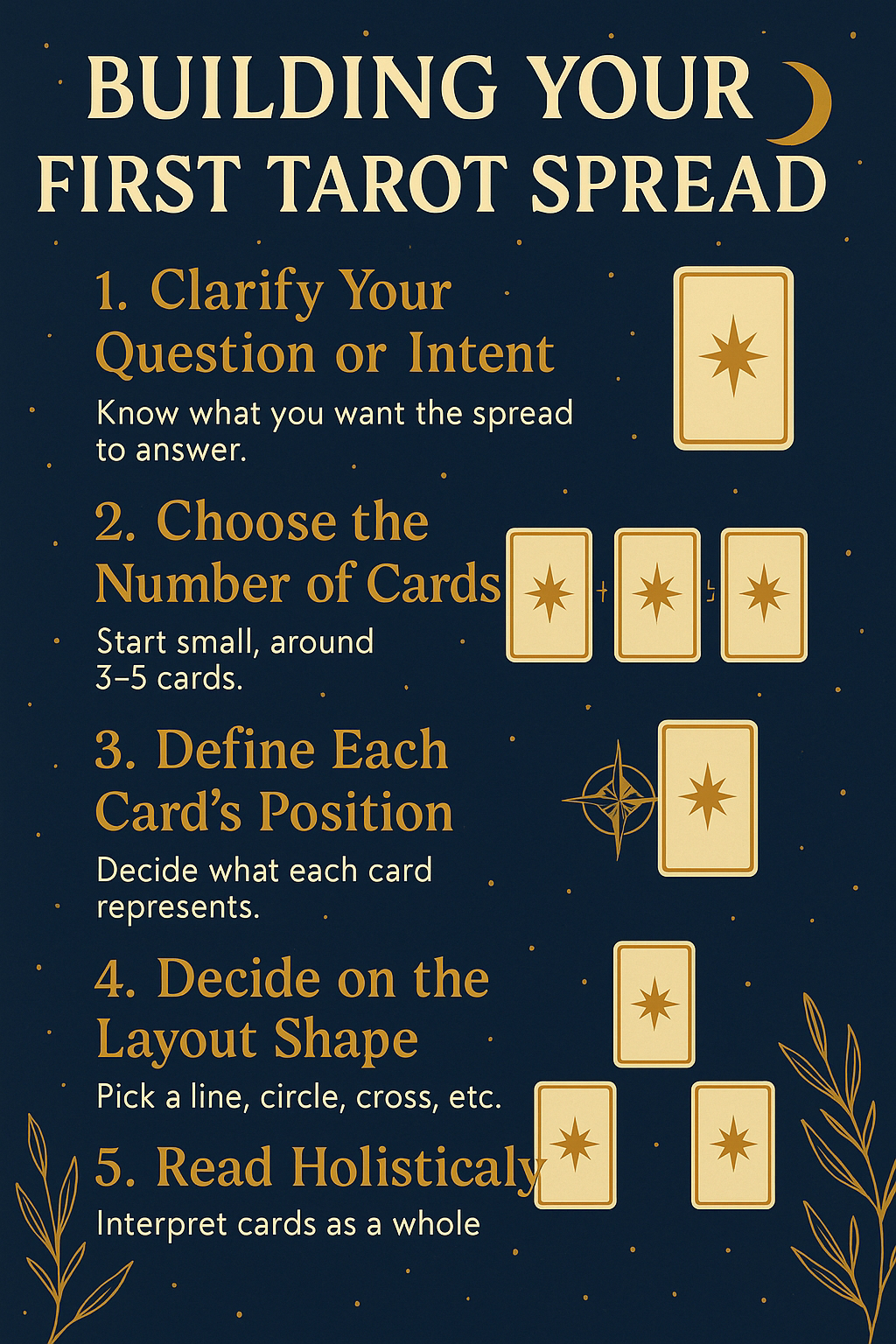
Building Your First Tarot Spread – A Beginner’s Guide

When you first begin learning tarot, it’s easy to rely on premade spreads—three-card spreads, Celtic Crosses, love layouts, and more. But there comes a point when you want something tailored to your question, your intuition, and your style. That’s where building your own tarot spread comes in.

Let’s walk through how to create your first custom spread—step by step.


✨ Step 1: Clarify Your Question or Intent

Before you shuffle a single card, get clear on what you want the spread to answer. Ask yourself:

  • What area of life am I exploring? (Love, career, self-growth, etc.)
  • Do I need insight, advice, confirmation, or a warning?
  • Do I want a broad overview or a deep dive?

The clearer your focus, the more helpful your spread will be.


🔮 Step 2: Choose the Number of Cards

Start small. For your first custom spread, 3–5 cards is ideal. Each card should have a clear position and purpose. Too many, and your message might get lost.

Examples:

  • 3-card spread: Past / Present / Future
  • 4-card spread: Situation / Obstacle / Advice / Outcome
  • 5-card spread: What I Know / What I Don’t / What’s Helping / What’s Hindering / What’s Next

🗺️ Step 3: Define Each Card’s Position

Each card should represent a unique part of the story or a specific energy. Write down what each card is meant to show before you draw. You might label your positions with:

  • Questions (What am I avoiding?)
  • Roles (My mindset / The outside influence)
  • Metaphors (The key / The lock / The door)

Creative positioning brings depth and meaning.


🧠 Step 4: Decide on the Layout Shape

You can lay the cards in a line, a circle, a triangle, or even a cross. The layout doesn’t have to be complex—but it should feel intentional. For example:

  • A triangle can represent balance or conflict
  • A straight line might reflect a timeline
  • A circle suggests a cycle or process

Let your intuition guide the shape.


🕯️ Step 5: Read Holistically

Once the cards are down, interpret them not just individually—but as a whole. How do they interact? What patterns or contradictions appear? Your spread isn’t just a row of separate messages—it’s a conversation.


💫 Bonus: Give Your Spread a Name

Naming your spread helps you remember it and gives it energy. Try:

  • “The Fog-Clearing Spread”
  • “Heart Over Head”
  • “What Needs to Change”

Personal names make your spread feel more like a magical tool and less like a formula.


🌙 Final Thoughts

Building your own tarot spread is one of the most empowering things you can do as a reader. It puts you in charge of the conversation. It allows your intuition to lead. And it ensures your readings are as unique as your journey.

So grab your deck, light a candle, and give it a try. The cards are waiting.